
- Date:
- Read time:
- 10 mins
Welcome to the January edition of InView: Monthly Global House View. In this publication we consider significant developments in the world’s markets, and discuss our key convictions and themes for the coming months.
The month of December saw a consolidation of the gains made in the first eleven months of the year following the re-election of Donald Trump to the White House. For 2024 as a whole, the MSCI All Country World Index rose 17.5% (in USD, net dividends reinvested), led once again by the US market and in particular by the Magnificent 7 mega-caps.
The improving growth outlook for the US economy, together with expectations of tax cuts and deregulation under the new Trump administration, supported the stock prices of US listed companies. A corollary, however, was an upward revision to the expected path of the fed funds rate, confirmed by Chairman Powell’s comments after the last Federal Open Market Committee meeting and the subsequent increase in US Treasury bond yields. Higher rates also encouraged a strengthening of the US dollar; the trade-weighted US dollar index rose to its highest level since late 2022.
The divergence of the economic cycle between the US and the rest of the world was illustrated by central bank meetings in December. Although the Federal Reserve cut the fed funds rate by 0.25%, it signalled that there is limited room for further easing in 2025. In contrast, the European Central Bank indicated that it will continue to cut interest rates in 2025 to counter downside risks to growth while the Swiss National Bank surprised with a 0.50% cut in December. The Bank of Japan postponed its expected rate increase and expressed caution on the extent to which rates will increase in 2025. In China, the central bank said that it will continue to pursue “supportive” monetary policy to help offset the negative impact to the economy from the large property sector debt overhang.
For the beginning of 2025, or at least until President Trump's inauguration on 20 January, we expect the upward trend in bond yields and stock market indices to continue. The outlook will then depend to a large extent on the policies of the new US administration in terms of trade, taxation and deregulation. Geopolitics, in particular developments in the Middle East and Ukraine, could also influence investors' perceptions of risks, especially with regard to European markets.
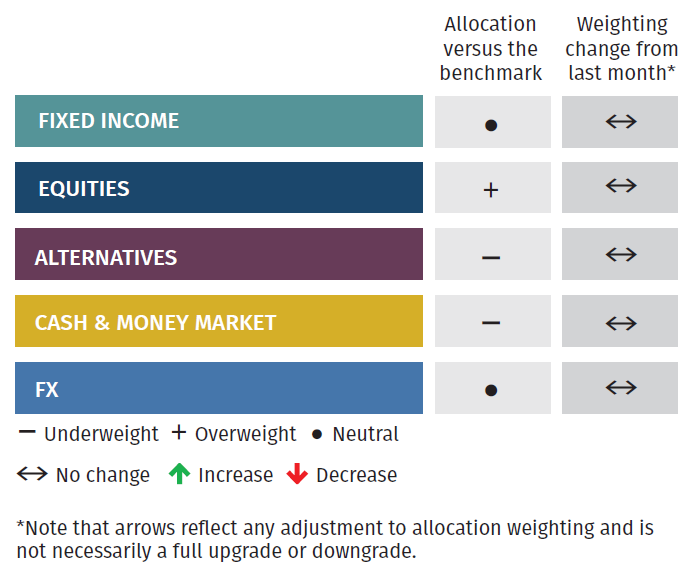
In terms of portfolio allocation, we maintain a preference for equities, especially US and European, a neutral exposure to fixed income securities and an underweight to liquidity.
Asset Allocation
Global Allocation
Going into 2025, no changes are being made to our broad asset allocation. Our overweight to equities is maintained, fixed income is held at a neutral position, while alternatives and cash are underweight. Close attention will be paid to Donald Trump’s inauguration on 20 January, with any necessary allocation changes being made closer to the date. If markets start 2025 very strongly, this could provide a reason to take some risk off the table, with the start of Trump’s presidency a potential catalyst for market sentiment to change. This is not a given but we expect nonetheless to assess the market environment closer to the inauguration date.
Fixed Income
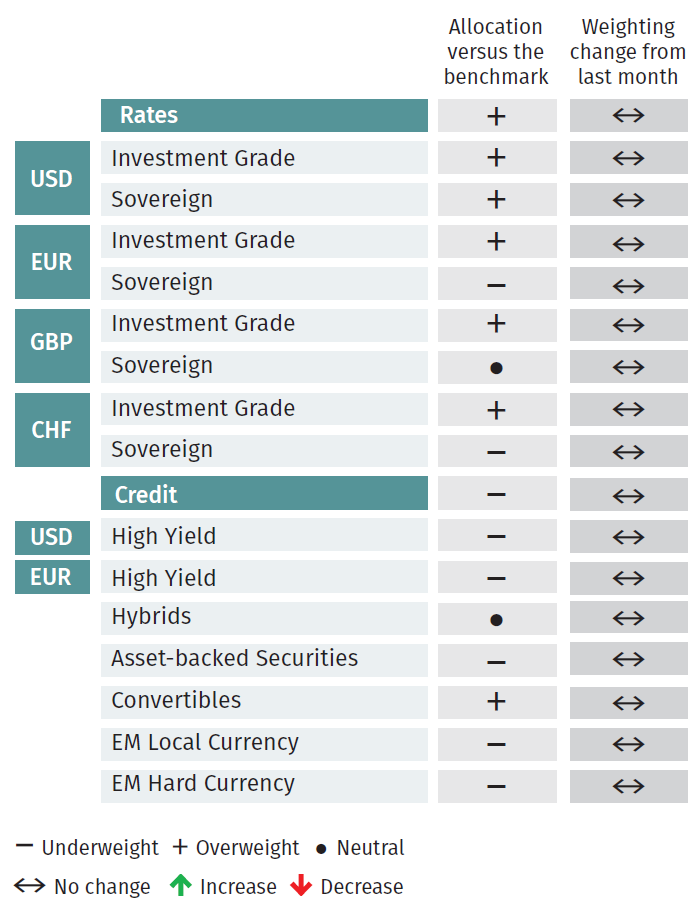
No changes are being made to our fixed income allocation after having cut rates exposure and increased credit last month. Sovereign bond exposure had been cut across currencies on the expectation of higher risk premia as Trump returns to office. With Trump coming in and pro-growth policies likely to be enacted, the risks of significant spread widening has reduced, providing a more positive environment for high yield bonds. We added to both USD and EUR high yield but remain underweight. Recently the US leading indicator has remained negative in 6-month annualised terms, while the lagging indicator has started to dip into negative territory. While this is not cause for panic, it is something to take note of in the context of rising auto loan and credit card defaults in the US. This could point to adding to duration in coming months as a way to hedge risk in a multi-asset portfolio.
Equities
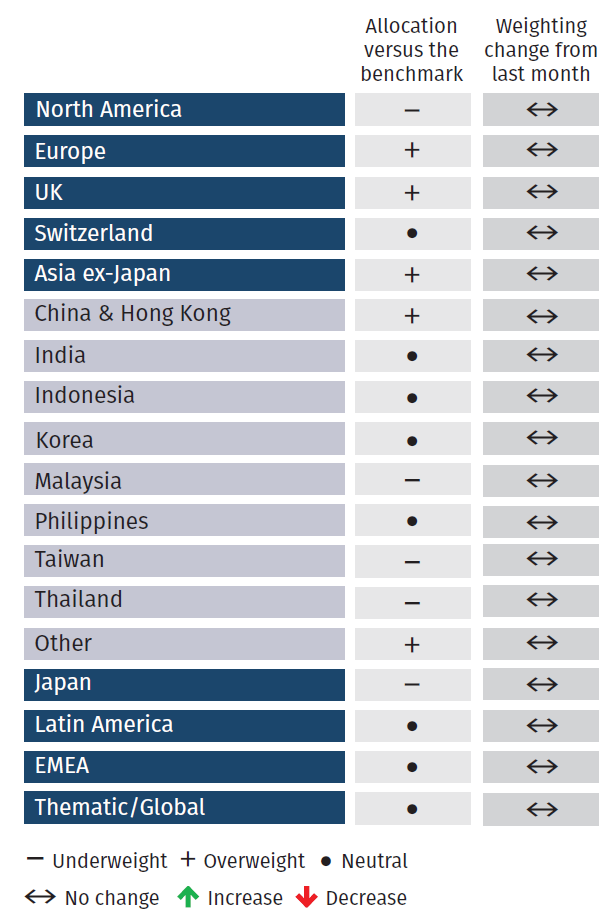
No changes are being made to the equity sub-asset allocation, having added to US exposure in the aftermath of the election. Despite the increase we still hold an underweight position to US equities versus the benchmark. While there are improved macro and risk factors in the US, we see little scope to increase exposure beyond the neutral weighting due to the sizeable weight of the US within the MSCI World Index benchmark. There is a possibility that European equities may close the gap with US equities in the coming months so we maintain our slight overweight to the region. Our valuation model points to European and UK equities being among the cheapest regions, while the US continues to look relatively expensive. The latest Bank of America fund manager survey shows that optimism over Chinese growth accelerating is viewed as the most bullish development in 2025 and we believe that this justifies our overweight allocation to Asian equities as a barbell approach to US equity risk.
Equity Sectors
Equity Sector Views
UK
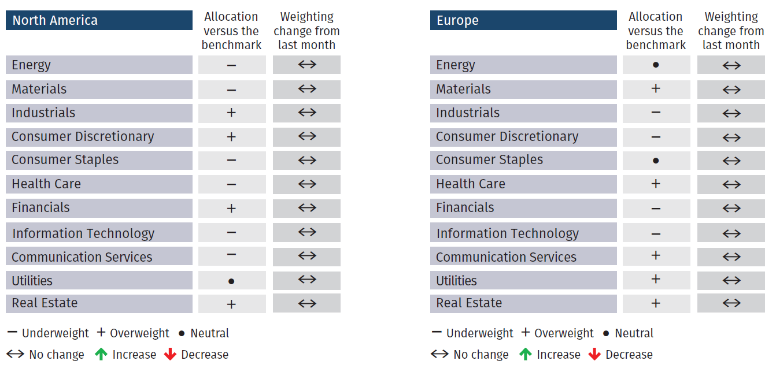
Following the outcome of the US election and an increasingly more resilient US macro recovery outlook, we have increased our exposure to internationally focused UK industrial names which are likely to benefit from this outlook, many of which will also benefit from the recent strengthening of the US dollar.
We continue to see an opportunity for the outperformance of UK midcaps over the coming quarters, reversing a multi-year period of underperformance through high inflation and interest rates as both of these factors normalise. Information Technology has been a sector in which we have found specialist UK companies trading on attractive valuations in our view backed by strong structural growth tailwinds.
Last year we have also increased our weighting towards consumer discretionary given our more constructive outlook for improving real incomes for consumers. Our exposure is balanced between internationally focused Hotel & Leisure businesses as well as domestic UK recovery geared names, such as housebuilders, which will be supported by both falling rates and the new Labour government which aims to reform the planning permission system to boost economic growth.
US
We increased the portfolio cyclicality following the US election results. The election outcome lessened unpredictability while Trump’s policies are expected to deliver benefits to US companies in the upcoming months. Specifically, we are overweight in industrials, consumer discretionary and financials. Following the nomination of Robert Kennedy Junior as health secretary, we downgraded our allocation in consumer staples and healthcare, owing to question marks on how aggressive his policies may be. We are underweight to defensive “bond proxy” stocks. Rising inflation expectations could result in interest rates staying high for an extended period. This scenario could put additional downward pressure on the valuation of defensive stocks.
Europe
Recently we have added to cyclical sectors such as financials and industrials although both remain underweight. These trades were funded by a slight reduction in healthcare and consumer staples. Our focus has been on adding capital to small and mid-caps versus the mega caps in the region.
Alternatives
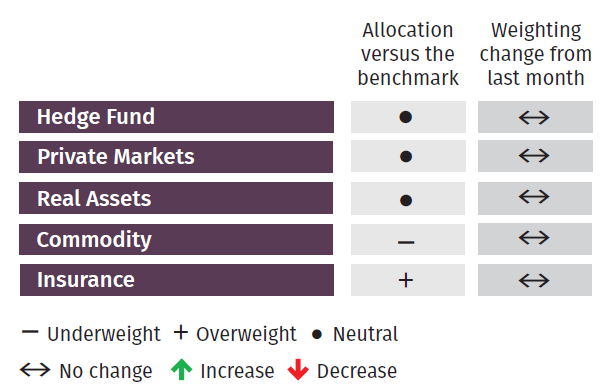
Previously we slightly increased our alternatives exposure, focusing on hedge funds and commodities. We expect that hedge funds could be poised to exploit more opportunities in a Trump regime. Meanwhile in our view Trump may be bearish for the oil price but better for the broader industrial and soft commodities. Insurance positioning remains overweight versus the benchmark, with our exposure being a useful portfolio component given its uncorrelated nature.
Important Information
The value of investments and the income derived from them can fall as well as rise, and past performance is no indicator of future performance. Investment products may be subject to investment risks involving, but not limited to, possible loss of all or part of the principal invested.
This document does not constitute and shall not be construed as a prospectus, advertisement, public offering or placement of, nor a recommendation to buy, sell, hold or solicit, any investment, security, other financial instrument or other product or service. It is not intended to be a final representation of the terms and conditions of any investment, security, other financial instrument or other product or service. This document is for general information only and is not intended as investment advice or any other specific recommendation as to any particular course of action or inaction. The information in this document does not take into account the specific investment objectives, financial situation or particular needs of the recipient. You should seek your own professional advice suitable to your particular circumstances prior to making any investment or if you are in doubt as to the information in this document.
Although information in this document has been obtained from sources believed to be reliable, no member of the EFG group represents or warrants its accuracy, and such information may be incomplete or condensed. Any opinions in this document are subject to change without notice. This document may contain personal opinions which do not necessarily reflect the position of any member of the EFG group. To the fullest extent permissible by law, no member of the EFG group shall be responsible for the consequences of any errors or omissions herein, or reliance upon any opinion or statement contained herein, and each member of the EFG group expressly disclaims any liability, including (without limitation) liability for incidental or consequential damages, arising from the same or resulting from any action or inaction on the part of the recipient in reliance on this document. The availability of this document in any jurisdiction or country may be contrary to local law or regulation and persons who come into possession of this document should inform themselves of and observe any restrictions. This document may not be reproduced, disclosed or distributed (in whole or in part) to any other person without prior written permission from an authorised member of the EFG group.
This document has been produced by EFG Asset Management (UK) Limited for use by the EFG group and the worldwide subsidiaries and affiliates within the EFG group. EFG Asset Management (UK) Limited is authorised and regulated by the UK Financial Conduct Authority, registered no. 7389746. Registered address: EFG Asset Management (UK) Limited, 116 Park Street, London W1K 6AP, United Kingdom, telephone +44 (0)20 7491 9111.
Independent Asset Managers: in case this document is provided to Independent Asset Managers (“IAMs“), it is strictly forbidden to be reproduced, disclosed or distributed (in whole or in part) by IAMs and made available to their clients and/or third parties. By receiving this document IAMs confirm that they will need to make their own decisions/judgements about how to proceed and it is the responsibility of IAMs to ensure that the information provided is in line with their own clients’ circumstances with regard to any investment, legal, regulatory, tax or other consequences. No liability is accepted by EFG for any damages, losses or costs (whether direct, indirect or consequential) that may arise from any use of this document by the IAMs, their clients or any third parties.