- Date:
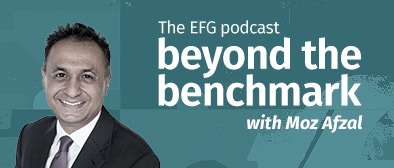
In the first of a special three-part series, Giorgio Pradelli, CEO of EFG International, joins Moz to discuss his personal and professional journey. From his early days in Torino, Italy, to leading one of Europe’s top private banks, Giorgio shares valuable insights on leadership, decision-making, building a strong company culture, and the importance of staying calm under pressure in today’s ever-changing business landscape.
Speaker
Giorgio Pradelli
Host
Moz Afzal
To listen to the full podcast episode, use the buttons below.
Welcome to Beyond the Benchmark, the EFG podcast with Moz Afzal.
Moz Afzal:
Hi everyone. So today we have a very special podcast. In fact, it's the first or a three part series that we'll be playing over the following months. But my special guest today is none other Giorgio Pradelli, CEO of EFG International. Giorgio, welcome.
Giorgio Pradelli:
Thank you. Thank you. And thank you for having me.
Moz Afzal:
Not at all, but we're obviously very honoured actually to have Giorgio here to give us some of his thoughts about leadership, management, vision and so forth today. But before we get into those topics, let's go into the background of Giorgio a little bit more. So Giorgio, obviously give us a little bit of your history, your background, how did you come to be EFG International's, CEO, but also maybe your humble beginnings in Italy.
Giorgio Pradelli:
Well, yeah, thank you. Thank you most. Well, yeah, I grew up in a city called Torino in northwest of Italy, which at the time was an industrial city known for Fiat and automobiles. And frankly in those days finance was very, very far away. But maybe if there are three things that maybe somehow I've been practising or I've been confronted since the early days, one was about languages. My parents strongly encouraged me, which is another way of saying force me to learn languages, which actually for me was very good. And I believe that languages somehow are the key to other countries, other people and languages allowed me to go out of Italy and work outside. And I've worked basically almost everywhere in Europe. The second point was I used to play basketball and actually I liked it much more than at the beginning as a teenager and maybe academics.
And I remember a coach saying, you got to play in the open spaces. You got to play where there is not too crowded. And somehow we have been trying to apply this also to the business and also to my career. Everybody was going to the UK when I graduated, I went to Germany and then everybody was doing a specific choice. I recall when I started in Deutsche, everybody wanted to go into investment banking, corporate finance, I went into private banking, asset management. And so I always try to go on a path that was not so beaten, let's put it that way. And the third was obviously about achieving targets. This is something we're going to discuss, but this has to do with work ethic. And obviously from early on I was brought up that you had to hit the targets and bring home the right average, otherwise there was no basketball and no other leisure activity. So these three tales from those days.
Moz Afzal:
So obviously for those who know Giorgio very well, it's either NNA or ROA. That is the mantra that we speak here at EFG. But in terms of thinking about the open spaces, what drew you EFG from that perspective?
Giorgio Pradelli:
Well, I have joined the EFG group in 2003 from Deutsche. So I've been only in two places in my career that started.
Moz Afzal:
I remember it well, I happened to be there when you joined.
Giorgio Pradelli:
Exactly. And the reason I joined is because at the time there was an entrepreneurial vision, and we're going to debate about that from the group, which obviously the group is controlled by the Latsis family at the time, as you recall very well, there were three small banks, private banks, one in London here, one in Switzerland, and one in Monaco, Monte Carlo. And the vision at the time, this was 2002, 2003, was that we had to bring these three companies, these three banks under a common roof holding and then do an IPO and then develop from there. Obviously at the time, all the three combined didn't have at probably about 30 billion assets under management. And the corporations were minimal, they were independent as I said. And at the time I said, well, I was suffering in a big bank from politics and the usual issues that sometimes big banks have, although I'm very grateful to Deutsche and to those years.
But I saw that there was this possibility of creating something new, something entrepreneurial to develop something. And I joined and indeed in 2005 then I was working at the time for the shareholder, so for the holding, owning EFG. And then this is what we did. We created a holding, which is today EFG International, which is the listed entity. We put all the three banks under the common roof. And then we did an IPO, which was very successful, as you remember in October, 2005, which is now 20 years. And then from 20 years we have seen this development. So was this entrepreneurial vision of developing something from almost scratch.
Moz Afzal:
Yeah, certainly. Very interesting. So moving then on finance, and I think we always look forward to reading Jamie Dimon's annual missive on particularly management and talent. What are the sort of key lessons from that?
Giorgio Pradelli:
I think about business, one of the best pieces I've read recently was indeed this letter. And in the letter to shareholders, there is a section about management learnings, which I found quite interesting and very up to date. And somehow this resonated with me. I've been following Jamie Dimon since the year 2000 actually when he was ousted from Citi and went into the province, so to speak, to lead the bank one. And then obviously, and I recall there was on the FT a major one of those weekend, FT weekend, one of these major portray. And the article was saying something or the title, he went to Main Street, but we are sure we're going to see him back into Wall Street. And then the rest of history obviously what I liked about this piece is that it is very, I always try to find ways to learn to improve.
And I find fascinating the leading and the management part of my job. And obviously you try to learn from the best and at the end we are a different sort of athletes and you try to see. And what I like is that there are certain, as you said, we are living in a very volatile, uncertain, complex, ambiguous time, which is the VUCA acronym. But there are certain issues, certain topics, certain ways or certain approaches to business and to leadership and to management that I think are valid throughout the cycle and maintaining the helm with the right course. Sometimes this is difficult because you think you need to change tack and my hobby is sailing. If you tack too often, you don't go very far. So no, what I like for example, it talks a lot about how culture is extremely important in a company that how we need to avoid to have bureaucracy and complacency.
This is something at EFGI must say we have done very well since 2019, so is the next last six, seven years that we're doing very well. And obviously complacency, inertia is a topic. Sometimes I say that our biggest competitors are not outside, are inside. And it talks about that in a very eloquent way. And this I find is universally valid obviously for a big company like JP Morgan for a global boutique like us. But in general, I also believe, and what I liked is also this notion that at the end of the day, yes, we are in a privileged position to lead, but at the end, without the team and without the teamwork and without people sharing the vision, you're not going to go very far. There are several points about the letter that somehow resonated.
And obviously the other key point, obviously Jamie Dimon is famous for that expression, is you never know what's going to happen. So you need to be somehow in a very solid position to withstand storms that can come from the left field and you don't see. And so this concept of to have a fortress balance sheet and to be very, very strong from our operational resilience and financial resilience, these are obviously also points that resonate. And the final point I would say is that everybody makes mistakes. And to be very honest about that, and this is something we might discuss later, but I am very focused on decision making. I think at the end our job is to take decisions to take as many decisions as necessary and as many right decision as possible. But you always take a wrong decision. And the key issue there is how do you learn from that and how do you change the process decision making process that led to the wrong decision and why? So these are very interesting points and again, it was written in a very eloquent but also simple way. Yeah,
Moz Afzal:
One of the lessons, well the two things that came to me first of all is when you do make a mistake, and I always have the same playbook every time, it's sort of accept made a mistake because often people don't accept that they've made a mistake or try to, not to brush it away, but to not tackle it straight on. So accept, analyse, correct, very simple three rules. And you can pretty much use that in most cases for
Giorgio Pradelli:
AAC
Moz Afzal:
AAC you can pretty much use those. Obviously I'm in financial markets like Federer, we're going to be wrong, 35, 40, maybe more 45% of the time. And so one needs to be humble enough and be able to use that playbook to be able to go back and course correct. So that's quite important.
Giorgio Pradelli:
Like you said, you need to accept that you've made a mistake. You should not remain in denial and actually go against all evidence. I think that's extremely important. That's the first phase. Many, many people get stuck in this grieving cycle that they made at the end. And you made reference to the speech of Federer at Dartmouth University. Obviously a point is the most important thing when you play it after that is gone and you need to move on and play the next point.
Moz Afzal:
Something very interesting. So let's move on to some of the key principles and I guess the first one is just really leadership in people. So what are your thoughts around that key topic?
Giorgio Pradelli:
Look, I like always to talk about leadership and governance together and people obviously I find that topic fascinating. And again, I used to be a CFO before I was in finance, I was very, how should I say, technocratic. And when I took over the role, obviously also in my previous role I had a leadership position in a way. But obviously as CEO, maybe the content in terms of complexity of the finance decreases obviously, but the leadership challenge and dealing with the teams, it grows exponentially. And I always found fascinating how you try to make sure that at the end you have to distil basically your views with the views of the team and you need to create a vision and then somehow in a magic way try to bring the organisation into that direction. I always talk about governance because sometimes leadership and I am obsessed with, and maybe because of my, I started in Deutsche or in Germany there was a major and in Switzerland a certain way too, this consensus culture.
So I'm quite obsessed with consensus building and consultations and making sure that everybody has the fair chance to express their opinion and the perspective. I believe that at the end of the day as leaders, you need to take decisions. And I believe that if more perspective are heard and taken into account they lead to a better decision making. But I also believe that leadership and you need to know what you want. So as a leader, you cannot be neutral at the end. You need to have a view. On the other hand, I also believe that governance is extremely important because if you have leadership without governance and without the proper decision-making process at times it can lead to one person driving or dominating too much a certain organisation. So for me, what I find fascinating is this interaction between having a clear leadership, having a clear vision, but then refining this division in a consultation and with the team.
And this comes the people that I'll mention in a minute. And then the governance, which is about having the right process in terms of decision making and people is essential because I must say I enjoy the role I have and the more I have it, the more I enjoy it. But it has to do with the people, it has to do with the team, it has to do with the fact that when you are in a team, especially in the difficult days, sometimes I ask myself whether I am more motivating the team or the team is more motivating me, but this mutual enforcement of having a clear direction that you express with the leadership team but have all the time, this feedback loop from the greater team and then everything in a well-oiled governance decision-making process. I think this is fascinating. The moment you think you found the formula, things change and you got to start from scratch. But this is something that interests me a lot.
Moz Afzal:
I guess it reminds me of some of my readings a long time ago around systems and processes, right? There is a system that repeat and rinse repeat and rinse, repeat and rinse, you keep on going through that process and obviously you need to refine from time to time, but if you have that systematic view and processes, you're less likely to make mistakes and follow the line.
Giorgio Pradelli:
The consistency and being systematic is extremely important. But for me, and this is why if I look at the three components, I believe that leadership is very important. If you don't know where you want to go, you can be super systematic but you don't go very far.
And I believe that both in negotiations, in sailing, in business, the first objective is to define what is the target? Where do we want to go, what is the vision? What do we aspire to? And as you know, we spend a lot of time with the team in defining hopefully a coherent vision that appeals not only to the leadership team but to everyone, including all our stakeholders, the clients, the shareholders, the colleagues, and obviously the regulators in our business, their key stakeholder. And for where we are relevant the communities, but then is to define, okay, if we want to go there, how do we do that? And one thing is to define the strategy and the vision and then the other is to execute it. And for that it's important to put all the elements of the puzzle together, the right leaders, the right team, the people, the motivation and the governance.
Moz Afzal:
So moving on to people and judgement
Giorgio Pradelli:
Well that's another issue which fascinates me because it's something that I don't know how to define really. At the end of the day, you need people that have the right judgement . You can have the best strategy, the best vision, you can have the best system of setting targets and forecasting and re-forecasting. You can have the best system and processes in place. But at the end, every day we are faced with so different issues that if the judgement of the people is not correct, you can write so many manuals and so many checklists that you want, the outcomes will not be the expected ones. And this for me is fascinating because it's not easy to transmit judgement . I believe you can refine your judgement , you can work on your judgement . And now for us, what has worked very, very well, coming back to the topic of culture as being in EFG when we introduced the values and the values for us were the key elements that somehow tried to drive basically how you interact and how you approach problems or challenges to solve. And the other thing that is also important is to try to empower the team to take their own decisions and make their own mistakes. And I believe that at the end you can refine your judgement only via trial and error.
Moz Afzal:
Yeah, no, absolutely. I think the values are super important as part of our appraisal process. So we know it very well inside out and it's interesting how people view those over time. And I think this process has been in for quite a few years now. So it's very much embedded in the culture that we have. I think also thinking about judgement , I always thinking of stressful situations. People often had misjudgments during stressful situations, but emotions probably the most important thing.
Giorgio Pradelli:
No, this is actually something I forgot and I fully agree with you. For me, when people ask me in managers what I look for, by the way, the judgement to be very fair, doesn't come from me. Comes actually from one of my bosses that by the way, I will not mention the name here, but I recall at the time I was quite young and he said, because I took good judgement in people. And at the time I was 30 something, I said, what is it? I said, I mean I always felt that was most important was the professional competence, which I still believe is a necessary condition obviously, but sometimes it's not sufficient and you need good judgement . And the other element coming back to what you just said is to be cool under fire. And this is again another boss that you also know that was telling me this guy is good or this person is good because it's cool on the fire. And to maintain a cool head and to have the right judgement when it's very stressful, when the stakes are high, when you don't know what you're doing, when you have limited information, when you're not time pressure, this is obviously extremely, extremely important and again, it's difficult to teach that, but it's something that you can refine, you can work on yourself. But anyway, I think all of us, we try to be as cool as we can on the fire and sometimes we do better. Other times we do less well.
Moz Afzal:
Yeah, every situation is different and we've had quite a few of those from COVID. Your job in your job, my job is pretty much every day is another stressful situation. So Giorgio, thank you very much. We are going to stop here. Obviously there are many more learnings we have to go through. This was a very interesting, very thought provoking conversation and no doubt we will continue the conversation over the coming months. We certainly looked forward to having you on the podcast again to talk about some of the other topics. I know we have quite a few, I think another four or five at least we want to go through. So with that, Giorgio, thank you very much. So that wraps us up for today and of course we will continue the conversation with Giorgio over the coming months and if you have any questions, please send them over to me and we'll try and answer them. Thank you very much and enjoy the rest of the day.
This podcast is provided for general information only and it seems a certain level of knowledge of financial markets, it it's provided for informational purposes only and should not be considered as an offer investment recommendation or solicitation to deal in any of the investments or products mentioned herein and does not constitute investment research. The views in this podcast are those of the contributors at the time of publication and do not necessarily reflect those of EFG international or new capital. The companies discussed in this podcast have been selected for illustrative purposes only, or to demonstrate our investment management style and not as an investment recommendation or indication of their future performance. The value of investments in the income from them can go down as well as up and investors may get back less than the amount invested. Past performance is not a guide to future returns, return projections or estimates, and provides no guarantee of future results.
Important Information
The value of investments and the income derived from them can fall as well as rise, and past performance is no indicator of future performance. Investment products may be subject to investment risks involving, but not limited to, possible loss of all or part of the principal invested.
This document does not constitute and shall not be construed as a prospectus, advertisement, public offering or placement of, nor a recommendation to buy, sell, hold or solicit, any investment, security, other financial instrument or other product or service. It is not intended to be a final representation of the terms and conditions of any investment, security, other financial instrument or other product or service. This document is for general information only and is not intended as investment advice or any other specific recommendation as to any particular course of action or inaction. The information in this document does not take into account the specific investment objectives, financial situation or particular needs of the recipient. You should seek your own professional advice suitable to your particular circumstances prior to making any investment or if you are in doubt as to the information in this document.
Although information in this document has been obtained from sources believed to be reliable, no member of the EFG group represents or warrants its accuracy, and such information may be incomplete or condensed. Any opinions in this document are subject to change without notice. This document may contain personal opinions which do not necessarily reflect the position of any member of the EFG group. To the fullest extent permissible by law, no member of the EFG group shall be responsible for the consequences of any errors or omissions herein, or reliance upon any opinion or statement contained herein, and each member of the EFG group expressly disclaims any liability, including (without limitation) liability for incidental or consequential damages, arising from the same or resulting from any action or inaction on the part of the recipient in reliance on this document.
The availability of this document in any jurisdiction or country may be contrary to local law or regulation and persons who come into possession of this document should inform themselves of and observe any restrictions. This document may not be reproduced, disclosed or distributed (in whole or in part) to any other person without prior written permission from an authorised member of the EFG group.
This document has been produced by EFG Asset Management (UK) Limited for use by the EFG group and the worldwide subsidiaries and affiliates within the EFG group. EFG Asset Management (UK) Limited is authorised and regulated by the UK Financial Conduct Authority, registered no. 7389746. Registered address: EFG Asset Management (UK) Limited, Park House, 116 Park Street, London W1K 6AP, United Kingdom, telephone +44 (0)20 7491 9111.