- Date:
In the wake of the 'big, beautiful bill', Don Rissmiller shares his view that 2026 and beyond look positive for the US economy. However, there may be some turbulence in the final months of 2025 as tariff disruption and geopolitical pressures wash through the system.
Speaker
Don Rissmiller
Host
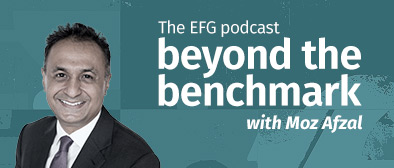
Moz Afzal
To listen to the full podcast episode, use the buttons below.
Welcome to Beyond the Benchmark, the EFG podcast with Moz Afzal.
Moz Afzal (00:06):
Hi everyone. I'm very happy today to have Don Rismiller from Strategist who's a Chief Economist and actually a regular participant in this podcast. I think this is the first time I've been doing it. I think Daniel Murray, my Deputy CEO has been doing it more recently. So Don, welcome.
Don Rissmiller (00:28):
Good to be here.
Moz Afzal (00:29):
Great. So Don, let's go straight to it. What is the state of the US economy at the moment? Obviously lots of volatility with numbers that are flying around everywhere and people being fired for revisions and so on, so forth. There's a huge amount to unpack at this point in time. But yeah, let's start with the landscape.
Don Rissmiller (00:54):
Absolutely, and it's understandable if you're confused when you look at what's happening recently in the US. So we had a very choppy first quarter and second quarter in terms of the real GDP reports and we can pin a lot of that on the trade and inventory components, which really did move around a lot. And we could think about consumers or importers trying to get ahead of some of the policies that they knew were coming. Tariffs are the obvious one, but that made the data very, very choppy. So we printed a 3% quarter to quarter annualised rate for the second quarter, but that's too strong relative to the underlying details of the report. We see a consumer sector which has slowed down. It hasn't really gone negative as best we can tell. And I say as best we can tell because we will get revisions to this data in the future as well.
(01:53):
There are some things that are working, if we look at the CapEx components, particularly the information processing piece of capital spending, that's at a very strong two quarters in a row. So the economy will be even weaker without some of those supports. So muddling through might be the best description we have in terms of real growth right now, the growth we have is narrow. That's the other way I think we could start out by discussing what's happening here. It's not an economy where we have manufacturing and housing and capital spending and consumer spending all working. We have pockets of things that are working and pockets of things that aren't working in the data right now.
Moz Afzal (02:37):
So let's start with CapEx. Obviously being very strong as you quite rightly said, looks like it will certainly continue for the time being. I guess from my part I always get a little bit confused, lots and lots of deals that Trump is doing with respect to as part of the tariff negotiations with spending back in the United States on manufacturing and also with the new bill, how much that will also accelerate some CapEx as well. Should we start with the CapEx? What's the shape of CapEx you think over the next six months, but actually beyond that as well?
Don Rissmiller (03:20):
Absolutely. So I think in the next six months we're really talking about tech and the AI build out and the power build out that go along with that. And that's really a private sector story mainly. There are some government provisions even from the prior administration that have helped with that, but that's mainly a technological build out for a particular reason. And so the economy would be even weaker if we didn't have that. So it is fortunate that we have that, but that's happening regardless of whether there are investment announcements for manufacturing that's going to return to the us. Those type of announcements are very, very hard to pin down right now. It's not something that the US has a competitive advantage in. You could think about maybe there are some national security reasons that you would want to go down this road, but you don't want the whole economy oriented towards something that's relatively inefficient.
(04:16):
So I think you'll get a few announcements but with dates that are quite far away. So if you see an investment announcement for 2028 or 2030, maybe that happens, maybe it doesn't. I mean some of these things may move beyond the current administration, which has three and a half years left. So I think it's part of the negotiating tactic that's being employed. I think there are reasons there might be some interest in building some things in the US but that might be a company that already has a US presence that may expand there. It's also possible they would've expanded anyway. It's unclear how much of this is greenfield and how much of this is something that would've been in the plan regardless of some of the nudging. So I think you have to be positive on tech CapEx near term. I think there's a real story there.
(05:14):
There's a race. Does this parallel some of the technological races of the 1960s, like the space race? There are some elements of that. I think that the private sector wants to win. They want the first mover advantage. There's a strong competitor in something like artificial intelligence out there in a country like China. So some of this doesn't have to be economical to happen. It's in the works and it's been committed to and only after the fact what we see, whether it was the right number or did we do too much, but doing too little here seems to be the biggest problem. So I think that's the story right now. And then longer term with these other pledges, I would not rely on them. I think they could be interesting, but I think they're almost beyond the investment horizon at this particular moment. Let's focus on the private sector, not the public sector here.
Moz Afzal (06:13):
And in terms of the Big Beautiful Bill itself and some of the, I guess manufacturing incentives, CapEx incentives that are being put through right now, do you think they'll have any short term or medium term impact?
Don Rissmiller (06:29):
Medium term, yes. I mean, but if we make it to 2026, you can find half a percent on GDP just from some of these CapEx provisions. So if we get beyond the next six months and move into 2026, there is support from that bill from the tax treatment. And so that's real. It's just getting from here to there. So beyond the very near term where I think there is a tech story, that's the bridge to some of these other provisions which do look quite pro-growth. So if we stretch this out to 12 to 18 months, then I think you have an additional support for capital spending generally on the tax side.
Moz Afzal (07:11):
So let's move to the other part, I guess housing where you've obviously been thinking a little bit about that. In fact very noticeable in the short term that some of the housing, house building stocks have suddenly perked up over the last few weeks, although the data clearly hasn't fairly mixed still very much on the data front, obviously that is a potential component of growth and economic stimulus and confidence from the consumer perspective, what are your thoughts around that?
Don Rissmiller (07:45):
Residential investment and I'd say the housing sector in general in the US has been sluggish for quite some time here. If we take a series like existing home sales as an example, a normal year for existing home sales will be about five and a half million. A good year coming out of the pandemic might be six and a half million. We've been stuck at four million existing home sales for about three years, so well below the average. In fact, that number is even below the COVID low, which we hit for a short period of time.
Moz Afzal (08:21):
Astonishing.
Don Rissmiller (08:21):
Yeah, it's really shocking. We're selling fewer homes than when nobody could leave their home back five years ago, and this is persistent, this isn't a one month event. This has now gone on for about three years and the most obvious reason is that with the structure of fixed rate mortgages, there's an incentive, a strong incentive in some case to stay put if you have a choice. So only those who have to relocate for personal reasons or business reasons are doing so. But if you might have relocated for retirement or because you wanted to live somewhere else, if that new home is smaller and cost more on a monthly payment, you may just choose to stay where you are. So the housing sector's been frozen for quite some time and this gets into all the ancillary effects in the economy on realtors or improvements or building items.
(09:23):
So this does affect the economy. The turnover itself affects the economy. New home sales have been doing better, but the numbers a lot smaller. So we're saying the existing home sales number should be five and a half million or so in normal times. I mean a new home sales number of 700,000 would be about what we can do. So you make a little bit of progress on new building and that has been working, but that's really been the only pressure relief valve and I think that helps explain a bit of what's gone on with the equities. So if we're anticipating some relief on interest rates from the Fed, that can provide some sort of floor, I'm not sure the Fed's going to lower interest rates enough to get the whole mortgage market moving. We'd have to lower back to where we were a few years ago and that's unlikely, but at least getting to neutral, opening up the option of maybe taking a five in one arm instead of a 30 year fixed.
(10:22):
There are some things at the margin that can help here. And we saw a whiff of activity, a whiff of refinancing last year when the Fed started with the rate cuts, but then they've paused all year here with the tariffs. So as we move beyond that uncertainty, I do think you resume the Fed rate cut cycle, they're going to do what other central banks have done over the course of this year and that should help a bit. So I don't think residential investment can be a huge driver to growth, but the performance has been so bad that even a little bit will look like an improvement.
Moz Afzal (11:00):
So moving then on to interest rate expectations, clearly I think consensus and of course you've moved to a September rate cut, I think that's pretty much in the bag. When do you see the next set of rate cuts? Do you see this continuous every meeting or pause and then go and where do you think the trough rate land at? What's your current thinking on that?
Don Rissmiller (11:29):
Sure. So I think the general goal here would be to get to neutral in terms of the policy. So right now I would describe the Fed, I think Fed Chair Powell would describe the FOMC stance as restrictive. We could debate whether it's modestly restrictive or moderately restrictive. There may be different answers to that question, but restrictive. And so, the goal over the next, let's call it year say by mid-2026, is to get the policy rate to neutral where neither provides stimulus nor restraint on the economy, given that there's likely to be change in the composition at the FOMC that we'll have new people next year. Neutral is not a bad setting anyway. I don't think that's the primary driver of the desire to get to neutral. But if you think we're going to have a new group of people handing them an FOMC that's neutral is a good setup.
(12:29):
You've done your job, you completed your cycle, and then that next group of people can decide what to do next. Do they continue rate cuts, do they reverse? And it would not be shocking if they lean a little more dovish given that the administration seems to be thinking about appointing people who have that proclivity. But for right now, let's say until May of 2026 when Fed Chair Powell's term ends, I think the goal is to get from where we are to neutral. So I think you see another rate cut in September, I would expect Powell at the Jackson hole meeting that is at the end of this month to preview that the Fed has used that meeting in the past to set up policy moves. Then it becomes a question of the speed, and it could be every meeting until you get there. It doesn't have to be though. We are likely to print some inflation readings over the next few months in particular, that could give you some pause. So I'm relatively certain that we're going from here to neutral and probably by mid next year, whether that's every meeting or do we do a 50 somewhere in there and skip a different meeting, I'm less convinced of that because you're going to try to get the committee on board.
Moz Afzal (13:47):
So just to clarify, where do you think neutral is?
Don Rissmiller (13:50):
Yeah, so I think it's about a 1% real rate. And so it depends what interest rate you want to wind up with the inflation added in. So the Fed in their forecast will almost always use a 2% inflation rate because that's the target. In fact, you could say it really can't use anything else. So if you look at the published forecast that's about a 3% nominal Fed funds, I'd be willing to nudge that up. In other words, I don't think you'd necessarily get all the way to the 2% inflation target. So are we talking three and a quarter nominal, something like that? I'd be willing to have a little bit of a move to the upside, but let's say three to three and a half I think would be a range where you could be in the zip code of neutral.
Moz Afzal (14:43):
In terms of money coming in as relative to the tariffs, they were, let's put a number out there, I don’t know, 300 billion or so. What's your sense of that? Is that 300 billion sustainable? I mean the first thing that I always think about is that if you've done a deal that you can move some manufacturing or some sort of services into the United States, then that 300 billion probably won't be sustainable. Is that the right way to think about it?
Don Rissmiller (15:15):
I think that's certainly fair. Let's take the reason you might put a tariff on, and I can think of four. The first three I think are pretty mainstream. So if you want revenue you could put on a tariff, you would probably argue there's a better way to get revenue. It's not the only way to get revenue. There might be a different way, a better way. You could think about a value added tax or something like that. But a tariff could provide revenue. It's reason number one. Reason number two is that there are political objectives that tariffs can achieve. So the US and Columbia, the US and Brazil, these seem to fall into that bucket again, you may argue there are different ways to achieve that goal through diplomacy or through some other angle, but that tool seems like it is going to stick around from time to time. It may not be the primary reason for tariffs.
Moz Afzal (16:10):
And it seems to be working.
Don Rissmiller (16:12):
Yeah, it seems to be working. Yeah, so why stop? But that'd be the second reason. I think that certainly sticks around. The third reason would be some sort of national security concern. Again here, maybe tariffs are suboptimal. Maybe you want a trade restriction rather than a tariff, but the idea that a tariff could intercept trade that you don't find in the interest of your national security could be justifiable. The US and the Soviet Union did not trade much and that was fine. I mean if there are national security concerns, you can justify interrupting trade. So revenue, politics, national security, I think those all stick around. The fourth reason, which I think is unique to this administration is there's that idea that the global trading system as it has functioned for decades, needs some change. And so if you're going to go down this route, so this is something like what Stephen Miran wrote about last November when he had a paper called the “User's Guide to Restructuring Trade.”
(17:17):
And so if you're going to go down this route, you really have to find something that's wrong with the textbook because the textbook explanation for free trade is pretty solid. But it does rely on some assumptions. And the assumption that seems to get picked on the most is that there's a problem in the currency market. So if you can analyse trade through the goods and service flows or you can analyse trade through the flow of currency of money and analysing it through the flow of money gives you an argument. And Miran has made this argument that the currency, the dollar has been structurally too strong because the capital flows back into the US have been quite large, that the US sits as a unique open liquid capital market attracting a lot of the flow of capital that's not obviously bad for the whole country. In fact, it's quite good for financial markets, for asset values, for those parts of the economy.
(18:19):
It is not good for domestic manufacturing. I think that's fair to say. If you have a currency that's not at its fair value, then you're really interfering with that part of the economy that should have been oriented towards goods exports. And so here I think parts of this are going to stick around parts of this recognition, parts of this desire to make some sort of change. There was a paper by David Autor came out earlier this year, so it's relatively new National Bureau of Economic Research paper. It was a group of authors. They got very detailed census data and so they had to sign all kinds of disclosures saying they were not going to reveal who anybody was. But then they were able to do work where they tracked towns in the US that competed with China and lost in terms of manufacturing and they were able to identify how individual people functioned over time.
(19:15):
And so the takeaway was that the town recovered, the people didn't. And so the town got a new industry. Eventually the factory closed, but a healthcare facility might've opened. The people who took the jobs in the new facility were either young, had been 17, 18, finished high school, went to work in the hospital, or it could have been a doctor who trained elsewhere and moved into the town to take that job in the new facility. But the individuals who were in the town who worked in the manufacturing plant basically just aged in place. That was the language used in the analysis. So I do think there's going to be something to address that and that's part of what the tariffs are aimed at initially. Maybe that has to be handed off to some sort of version of industrial policy, maybe a small industrial policy, something along those lines.
(20:11):
Maybe it's targeted towards three or four industries. Silicon Valley really likes that would I think be the best answer here is to try to preserve the manufacturing jobs that are left because losing them seems to have consequences that go beyond the typical labour market theory. The workers do not retrain, they do not move. They do not function in a very fluid way. So I think trying to address the problem in the currency market that is perceived by this administration and then known issues in the labour market will persist. Tariffs do some of that, but more other policies could address some of those issues. Maybe the tariffs could at least stop being implemented at the same pace or tariffs are taxes. So what we have is a tax code that's very complex right now.
Moz Afzal (21:01):
Yeah, yeah, it is a mess. Just flipping back to the economy again, we talked about CapEx housing impact obviously interest rate sensitivity. Another point you've been writing quite extensively about is this stratification of wealth. So the wealthiest seem to be doing pretty well, obviously much more correlated to the stock market and so forth. And then you've got the other end of spectrum that is still relatively suffering. Maybe you can describe that and your thinking around that, but more importantly then, how do you think that gets addressed from a policy perspective if indeed it does?
Don Rissmiller (21:48):
Yeah, absolutely. So the best data we have would say that the lower income cohorts are kind of muddling through and then a lot of the growth is in the upper income cohorts when it comes to consumer spending. And so the lower income cohorts have actually seen quite a bit of stress. If we look at mortgage delinquencies or credit card delinquencies, it's somewhat surprising they're holding together at all. And one of the things I think it's underestimated, and I think it's underestimated partly because the data's not great, is the gig economy. So there is a series on multiple job holders that comes out of the Bureau of Labour statistics. It's been increasing a bit recently up until the last reading, but the share that it says we're dealing with in terms of the labour markets about 5% and that seems low. There's some other estimates that five could really be more like a 30.
(22:43):
There are quite a few people involved in gig work. And so this may not be the best job. It may not even be something somebody reports as a job. That's part of the problem they're doing Uber one day a week or Instacart or DoorDash or social media or all these things, but it is a source of income, may not have a pension or a 401(k) or vacation or health insurance. But it's a way if you needed a hundred dollars this afternoon and you had a phone in a car, I mean you have a shot making it work, taking one seventh of a job or one half of a job or something like that to increase the spending power. So I think that's been particularly important for that lower income cohort at managing through some of this. If we did not have the gig economy, I think it would be much worse.
(23:35):
If we did not have the gig economy, I think jobless claims would've risen by now. So we're seeing initial claims hold at relatively low numbers. Anything below 260,000 on a weekly initial claims number I think we have to say is quite good. Continuing claims are creeping up. So if you do lose your job, it's hard to find another one. But the action in the firing space is not terribly substantial. And so I think that interplay of gig jobs, certain sectors like healthcare, healthcare is still adding jobs that's reflecting an ageing demographic, elder care, social assistance as well, but that's really patching part of the economy and then the action happens at the upper income part of the distribution. There's some data we get from the government says the top 20% of income earners do 40% of the spending. Even that may be skewed because the very high income earners don't report into this survey enough.
(24:31):
So we could say the top 10% maybe do that much, maybe a little more of the spending. So it's probably even more skewed than some of the official data, but it's skewed either way and it's heavily skewed either way. And for that cohort, I think it's a wealth effect. So if you have the stock market near a new high and you have home prices up over a number of years, there's a degree of comfort with continuing to spend. And so we have that right now, but this is also the reason that the government really can't allow a financial crisis. There's a lot of effort here to manage parts of the treasury market to make sure we don't have an interruption in the banking system. There's a very aggressive response a couple of years ago to some of the bank panics that we had. And so if you're really relying on the upper income consumer to drive growth, you have to pay a lot of attention to financial conditions. Those are still benign. Credit spreads are still narrow, equities are still performing, so we're okay. There's no emergency, but we're also sensitive to that. We have to monitor it going forward.
Moz Afzal (25:36):
No, I think that's very well put. So coming up to wrapping up here, but in terms of your 6th and then 12th month outlook, obviously we get next year seems to be actually not bad. Hopefully we get those rate cuts through and that pushes the economy more or pushes it forward. I'd also say international conditions are pretty decent. So I would say the ECB has been ahead of the curve. It's very unusual to see the ECB ahead of the curve with respect to rate cuts relative to the Fed is usually the opposite around usually the Fed’s cutting first and the ECB’s is catching up, but the rest of the world seems a lot more stable than it normally does. Usually the US is leading the economy's weaker or stronger if you like, and then everyone else is with a lag catching up. That doesn't seem to be the case this time around.
Don Rissmiller (26:37):
I think that's right. I think the Fed had a unique situation with the tariffs domestically and they chose to pause the rate cut cycle. I think they're going to resume. I think they're going to wind up doing what other countries have already done just with a shift in the calendar, let's say, of nine months out to September. So I think that's right. I think they will echo that just with an odd lag in this case. But the problem I see is really in the next three months, I mean, could we print a problem with the third quarter gross domestic product number? I mean, that's where I see the weak spot. Could we print a zero? Could we print a negative payroll number here? We still have government layoffs that are moving through the system. They're going to have to roll off the payroll at some point.
(27:23):
That's certainly plausible. We come in one month and the next three and then you print a down non-farm payrolls number, could you print a bad inflation number on core goods? Core goods are only about 20% of the CPI, but if you get a month where you have some spike, that's plausible at the same time too. So we're set up in the next three months for some sort of stagflationary scare. I would fade it. I think it's transitory. I mean I know that's a bad word in the last three years. I know the Fed doesn't like it. They used it and it was not right. But this has all the hallmarks of a one-time shock. That should be a price level shift and then we move beyond it as well as some special factors in government employment that we can get passed. Lots of supports for 2026 if we make it through the next few months.
(28:13):
You have fiscal, one Big Beautiful Bill, capital spending incentives. You have regulatory should have a deregulatory environment that could include banks could include energy. You should have the effect of some Fed rate cuts starting to work. And then whatever we wind up with on trade should start to stabilise even if we don't like the answer at least I think there should be some certainty. And if we're kind of iterating to some sort of annoying but relatively moderate national sales tax like number, I think we can live with it. It's not a big enough shock in itself to derail the US economy.
Moz Afzal (28:49):
Well Don, thank you very much again for coming on the podcast. It was very interesting as always, and we'll watch very carefully the data and the information and the GDP data over the coming weeks and months. I guess we'll watch out for Jackson Hole to see if the Fed can maybe see us through that valley, but suddenly there'll be a bit of volatility potentially coming up in that sort of late Q3, early Q4 period. So thank you very much.
This podcast is provided for general information only and it seems a certain level of knowledge of financial, IT is provided for informational purposes only and should not be considered as an offer investment recommendation or solicitation to deal in any of the investments or products mentioned herein and does not constitute investment research. The views in this podcast are those of the contributors at the time of publication and do not necessarily reflect those of EFG international or new capital. The companies discussed in this podcast have been selected for illustrative purposes only, or to demonstrate our investment management style and not as an investment recommendation or indication of their future performance. The value of investments and the income from them can go down as well as up, and investors may get back less than the amount invested. Past performance is not a guide to future returns, return projections or estimates, and provides no guarantee of future results.
Important Information
The value of investments and the income derived from them can fall as well as rise, and past performance is no indicator of future performance. Investment products may be subject to investment risks involving, but not limited to, possible loss of all or part of the principal invested.
This document does not constitute and shall not be construed as a prospectus, advertisement, public offering or placement of, nor a recommendation to buy, sell, hold or solicit, any investment, security, other financial instrument or other product or service. It is not intended to be a final representation of the terms and conditions of any investment, security, other financial instrument or other product or service. This document is for general information only and is not intended as investment advice or any other specific recommendation as to any particular course of action or inaction. The information in this document does not take into account the specific investment objectives, financial situation or particular needs of the recipient. You should seek your own professional advice suitable to your particular circumstances prior to making any investment or if you are in doubt as to the information in this document.
Although information in this document has been obtained from sources believed to be reliable, no member of the EFG group represents or warrants its accuracy, and such information may be incomplete or condensed. Any opinions in this document are subject to change without notice. This document may contain personal opinions which do not necessarily reflect the position of any member of the EFG group. To the fullest extent permissible by law, no member of the EFG group shall be responsible for the consequences of any errors or omissions herein, or reliance upon any opinion or statement contained herein, and each member of the EFG group expressly disclaims any liability, including (without limitation) liability for incidental or consequential damages, arising from the same or resulting from any action or inaction on the part of the recipient in reliance on this document.
The availability of this document in any jurisdiction or country may be contrary to local law or regulation and persons who come into possession of this document should inform themselves of and observe any restrictions. This document may not be reproduced, disclosed or distributed (in whole or in part) to any other person without prior written permission from an authorised member of the EFG group.
This document has been produced by EFG Asset Management (UK) Limited for use by the EFG group and the worldwide subsidiaries and affiliates within the EFG group. EFG Asset Management (UK) Limited is authorised and regulated by the UK Financial Conduct Authority, registered no. 7389746. Registered address: EFG Asset Management (UK) Limited, Park House, 116 Park Street, London W1K 6AP, United Kingdom, telephone +44 (0)20 7491 9111.